 Stargate
 sends bridged assets to a wallet or a composer that can execute destination actions
Stargate sends assets across supported chains to a wallet address or a composer contract that handles a destination action. A wallet transfer finishes with token delivery to the recipient. A composed transfer directs the asset to a contract, with instructions that can trigger a swap or vault deposit. For a first transfer, the recipient, destination token, and minimum receiving amount need to match the intended outcome before signing. Taxi supports composition and is the delivery mode established by the October 2026 change. Source-chain success confirms the send; destination receipt and any requested contract action need their own completion evidence. A quote provides a stopping point before funds move.
· last updated
Recipient Choice and the Destination Result
The destination address determines who first receives the bridged asset and whether a contract can act on arrival. Direct delivery uses the receiving wallet as the recipient, with no destination action encoded. Composition uses the destination composer as the recipient, even when another address ultimately benefits from the action. The
to
field must identify the contract that handles the message, so this address choice comes before preparing execution data.
Delivery to a Wallet
The selected route determines which token appears in the receiving wallet, including whether it is a native pool asset or a Hydra representation. Matching symbols don't establish identical token contracts or backing. A direct wallet transfer delivers the intended asset, with no application action requested through composition. A later swap or deposit follows the destination application's own token requirements, which may exclude the representation that arrived.
Delivery to a Composer
A composer receives the token and the encoded message, using its own contract logic to handle the requested destination action. Taxi provides the composition path, while the contract implements the actual behavior. A vault deposit or swap therefore requires compatible contract logic, the expected token, and appropriate execution gas. Writing an action's name into
composeMsg
doesn't supply executable contract behavior.
Quotes and Permissions Before Signing
Stargate V2 transfer setup combines the asset quote, token authorization where required, and the messaging-fee quote before submission. The contracts implement the Omnichain Fungible Token (OFT) interface, which includes
quoteOFT()
for transfer limits and expected token amounts.
quoteSend()
returns the messaging fee for the configured transfer. The expected receiving amount describes the token output, while the messaging fee covers cross-chain verification and execution. Quoting is read-only; the applicable authorization and send operations change on-chain state.
The Minimum Receiving Amount
Slippage protection uses
minAmountLD
to constrain the fee-adjusted output in a V2 send. The contract applies its decimal conversion before checking that minimum. A smaller minimum permits less output; a larger one can reject a transfer whose output falls short. The preview's sent and received amounts therefore need separate attention. Set the requested amount within the route's quoted limits, and base the minimum on the destination amount that the quote actually describes. The quoted maximum reflects the path's credit setting, which can change before the send executes.
Authorization for the Selected Asset
The deployed contract's
approvalRequired()
result determines whether token approval is necessary for that asset. Its
token()
method identifies the underlying token, using the zero address for a native asset. An ERC-20 transfer that requires approval needs the relevant source contract's allowance before it can debit the wallet. Approval changes a spending permission; it doesn't complete the cross-chain send. Token symbols alone can't choose the correct authorization behavior.
Fresh Messaging Fees
The messaging quote covers the configured LayerZero verification and execution services. Its
nativeFee
describes payment in the source chain's native asset when that payment mode applies. Source-chain transaction gas is an additional wallet cost. Quotes can change with gas prices, price feeds, and verification-service fees. OFT transfers through the bridge app can also carry an app-specific product fee. Direct integrations don't inherit that app-specific charge.
Refreshing
quoteSend()
near submission keeps its estimate aligned with current execution inputs. Changing the recipient, destination, or composition options changes the transfer that the quote must describe.
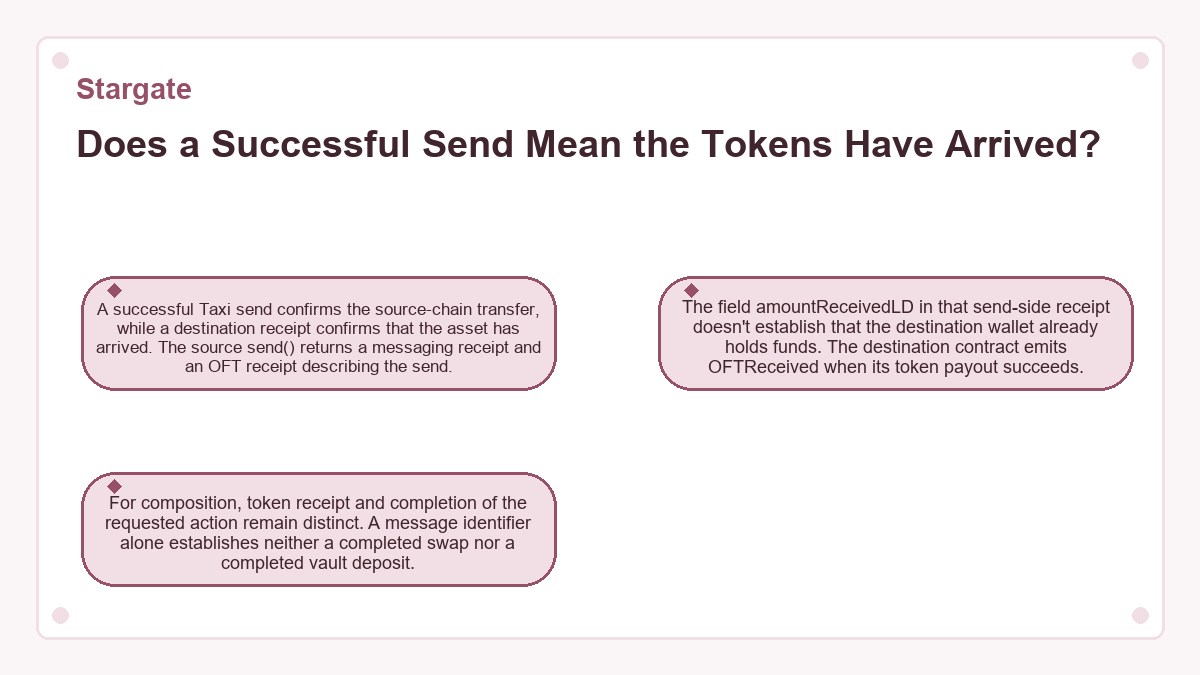
Does a Successful Send Mean the Tokens Have Arrived?
A successful Taxi send confirms the source-chain transfer, while a destination receipt confirms that the asset has arrived. The source
send()
returns a messaging receipt and an OFT receipt describing the send. The field
amountReceivedLD
in that send-side receipt doesn't establish that the destination wallet already holds funds.
The destination contract emits
OFTReceived
when its token payout succeeds.
For composition, token receipt and completion of the requested action remain distinct. A message identifier alone establishes neither a completed swap nor a completed vault deposit.
V2 Asset Pathways and Composition
The receiving token comes from the selected V2 pathway; choosing a composer adds destination logic to that pathway. Moving between native pools yields a native pool asset, whereas a Hydra destination yields a pool-backed OFT. That distinction affects whether a wallet receives the intended token or a contract can consume it. Composition follows the transfer's asset handling; it doesn't substitute a different asset for an incompatible one.
| Supported V2 Option | Asset Handling | Destination Result |
|---|---|---|
| Pool-to-pool | Source assets enter a pool; the destination pool pays out. | The recipient receives native pool assets. |
| Pool-to-Hydra OFT | Pool assets back newly minted Hydra tokens. | The recipient receives the route's Hydra representation. |
| Hydra OFT-to-Hydra OFT | Tokens burn at the source and mint at the destination. | The recipient receives the destination Hydra OFT. |
| Hydra OFT-to-pool | Hydra tokens burn, and the destination pool releases native assets. | The recipient receives native pool assets. |
| Taxi with composition | The transferred asset reaches the composer contract. | Compatible contract logic can execute the encoded action. |
A route offered in the bridge interface needn't be a
StargatePool
or
StargateOFT
path. Broader OFT support in that interface doesn't make every token a pool-backed Hydra asset. The composer's expected token has to match the asset that the actual route delivers. Interface availability alone doesn't establish that a particular composer's logic supports that token.
Taxi Delivery After the Bus Change
The operational delivery policy directs first Stargate transfers to Taxi, even though V2 contract code still includes Bus. The Taxi-only operational delivery policy has an effective date of October 1, 2026. Bus code batches multiple transfers into one message for gas efficiency, without destination composition. Taxi sends an individual transfer without Bus batching; destination arrival still requires LayerZero verification and execution.
Composer Setup and the Point of Commitment
A composed first send needs compatible destination logic, correctly encoded action data, and execution options that cover the composer's work. The deployment and message format must agree on how to interpret those instructions. A generic description such as a swap or vault deposit doesn't specify that format. Read-only quoting leaves the wallet's funds untouched, so you can preview the transfer before any required approval or submission.
Separate Delivery Gas From Composition Gas
A V2 integration requests Taxi with an empty
oftCmd
and encodes the action in
composeMsg
. The
to
field points to the composer. Execution options add gas for
lzCompose()
through
addExecutorLzComposeOption()
. Delivery and composition consume gas for different work. A budget for receiving tokens doesn't, by itself, fund the composer's full logic.
A Quote, an Approval, or a Send
A quote is a read-only preview. An approval changes the spender's permission, and a send commits the transfer on the source chain.
An unsent quote leaves the asset available in the sending wallet. Once a source transfer succeeds, closing the browser doesn't undo it. A direct wallet transfer leaves any later swap or deposit as a separate action after receipt. Composition joins delivery to programmed destination behavior, increasing the contract and execution requirements that need to be settled before the first send.
FAQ
Which Address Receives Excess Messaging-Fee Payments?
The refund address supplied to send() receives any refundable excess LayerZero messaging fees. It is separate from the to field of SendParam, which names the destination asset recipient. A composer address in that field doesn't automatically become the refund address. A fee refund concerns the excess payment, not the bridged token amount.
How Are Amounts Encoded in a First V2 Contract Call?
V2 contract calls express amountLD and minAmountLD as integer amounts in the source asset's local decimal units. Convert a human-readable token amount with that asset's decimals before supplying either field. The quote reports transfer amounts in local units as well, and the protocol handles shared-decimal conversions internally.
Does Non-EVM Interface Support Apply to Direct V2 Contract Calls?
Direct Stargate V2 protocol contracts operate on EVM chains. The bridge interface has broader coverage, including LayerZero OFT transfers across non-EVM networks. Interface availability therefore doesn't establish a StargatePool or StargateOFT deployment on that destination. A contract integration needs a supported deployment and pathway for its asset; a transfer shown in the app may use a different protocol family.
Can a Standard OFT Message Go Straight Into a Stargate V2 Contract?
A shared IOFT interface doesn't make token-message formats interchangeable. Stargate V2 reports message-encoding version 0 through oftVersion(), which isn't compatible with the default OFT encoding. Its transfers use Stargate's configured token-messaging contracts. The bridge interface can route other LayerZero OFTs separately, so a common send interface doesn't establish message compatibility between their transfer contracts.
What Happens If Token Delivery Fails After the Message Arrives?
A failed destination token payout can create an unreceived-token cache entry in Stargate V2. When the contract isn't paused, retryReceiveToken() lets anyone retry a cached receive with the matching message details. The function checks those details against the stored entry and emits OFTReceived on a successful payout. This recovery path concerns token receipt; it doesn't establish that a separately composed swap or deposit succeeded.
Must the Sending Wallet Be a Composed Action's Final Beneficiary?
A composer can support a different final beneficiary if its encoded message and contract logic provide for that recipient. The to field of SendParam names the destination composer, while composeMsg can carry the ultimate recipient along with action parameters. This distinction doesn't create an automatic forwarding rule: the receiving contract must implement it. Its beneficiary handling therefore needs to match the intended deposit, swap, or other supported action.
Is STG Staking Needed Before a First Stargate Transfer?
An STG staking position isn't a prerequisite for a Stargate V2 transfer. The transfer contract uses the selected asset, transfer parameters, and required fees. STG staking ended during the 2025 acquisition transition, while cross-chain transfers continued. Readiness for a first send concerns whether the wallet can supply the chosen asset and the quoted fee payment.